
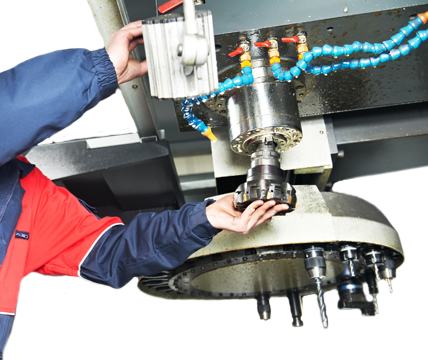
In our 40+ years servicing CNC equipment across New England, we've responded to countless emergency calls that could have been prevented. The difference between a scheduled repair and an emergency breakdown often comes down to recognizing the warning signs early.
Here are the seven most critical warning signs that indicate your CNC machine needs immediate attention.
1. Unusual Sounds or Vibrations
Your CNC machine has a normal operating sound—you know it well. When that changes, pay attention.
Sounds that demand immediate investigation:
- Grinding or scraping: Often indicates bearing failure or metal-to-metal contact
- High-pitched whining: Could signal spindle bearing problems
- Clicking or popping: May indicate electrical issues or loose components
- Rhythmic thumping: Often points to ball screw or linear guide problems
2. Increasing Part Rejection Rates
If your scrap rate is climbing and you've ruled out programming errors and tooling issues, the machine itself is likely drifting out of specification.
What to look for:
- Parts consistently out of tolerance in the same direction
- Dimensions that vary from part to part
- Features that were previously in tolerance now failing inspection
- Surface finish degradation without tooling changes
Don't assume it's an operator issue—track the data. If rejections are increasing across multiple jobs and operators, it's time for a machine evaluation.
3. Visible Oil Leaks or Fluid Loss
CNC machines are designed to contain their fluids. When you see puddles or increased fluid consumption, something is wrong.
Common leak sources and their implications:
- Hydraulic fluid: Can indicate seal failure, which will worsen rapidly
- Way lube: Starved guideways will wear quickly and damage expensive components
- Coolant: Beyond the mess, coolant in wrong places can damage electronics
- Spindle oil: Critical for spindle longevity—address immediately
4. Thermal Issues and Overheating
Modern CNC machines generate heat, but they're designed to manage it. Overheating indicates a system under stress.
Signs of thermal problems:
- Cabinet fans running constantly at high speed
- Thermal error alarms
- Hot spots you can feel on the machine
- Parts that only go out of tolerance after extended running
- Spindle that takes longer than usual to warm up or runs hot
This is especially critical during New England summers when ambient temperatures rise. Thermal issues that were marginal in winter often become failures in July.
5. Electrical Anomalies
Electrical problems tend to get worse over time, not better. Early intervention prevents bigger issues.
Warning signs include:
- Intermittent alarms that clear themselves
- Sporadic axis faults
- Display flickering or glitches
- Programs that sometimes don't load correctly
- Random tool magazine errors
- Encoders showing position errors
6. Backlash or Lost Motion
When you notice backlash in any axis, the problem is already significant. Backlash indicates wear in ball screws, nuts, or linear guides.
How to detect backlash:
- Parts have dimensional differences depending on approach direction
- Circles come out as ellipses
- You can feel play when manually moving an axis
- Arc movements show stepping or irregularities
- Ball bar test shows backlash spikes
Small amounts of backlash can sometimes be compensated in the control, but this is a temporary measure. The underlying mechanical problem will continue to worsen.
7. Coolant System Problems
Coolant system issues affect both part quality and machine longevity. Don't dismiss them as minor inconveniences.
Signs your coolant system needs attention:
- Reduced coolant flow or pressure
- Coolant not reaching the cutting zone
- Foul odor (bacterial growth)
- Pump making unusual sounds
- Foaming or separation in the tank
- Clogged filters requiring frequent changes
A failing coolant system leads to poor tool life, bad surface finish, and can allow chips to accumulate where they cause real damage.
The Cost of Waiting
We understand the temptation to "run it until it breaks." Production pressures are real, and scheduling downtime is challenging. But consider the math:
- Planned repair: Schedule around production, order parts in advance, minimize downtime
- Emergency breakdown: Production stops immediately, rush shipping for parts, overtime labor costs, potential cascade failures
A ball screw replacement scheduled proactively might cost $3,000-$5,000 with 1-2 days of planned downtime. The same failure as an emergency could cost $8,000-$12,000 with a week of unplanned downtime while waiting for parts.
What to Do When You Notice Warning Signs
- Document everything: When did it start? How often does it occur? What conditions trigger it?
- Don't ignore intermittent problems: They always get worse
- Contact a qualified service provider: Get a professional diagnosis before small problems become big ones
- Plan for service: Work with your service provider to schedule repairs during slower periods
24/7 Emergency CNC Repair Service
When your CNC machine shows warning signs—or when it's already down—Maz CNC is here to help. Our technicians serve all of New England with fast response times and the expertise to get you back in production.
Contact Us NowEmergency Line: (603) 562-4759